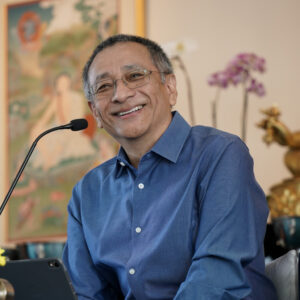
“Whether that is an object, a person or a state of mind, whatever it is, we long for it, but it remains out of reach. Then, at the very point where we totally give up and let go of it, we get what we have been wishing for.”
―Dzogchen Ponlop Rinpoche, Mind Beyond Death
When we are totally lost and suffering, what would it be like to give up? If we no longer wanted the things out of reach, would we see that we are free?
Our preferred version of ourselves (what we want, what we don’t want, who we think we should be) is not an inspiration, it is a tyranny. How we think about giving up—our attitude toward it, our obsession with it, our disavowal of its significance—may be a clue to something we should really call our histories and not our “selves.” What do we imagine giving up is actually like?
To give up hope, for example, would just mean to give up wanting a specific outcome. Giving up is always like that: giving up wanting something or someone, giving up wanting to be someone. The thing to be given up is the wanting.
We seem to consistently return to our ego ideals. There’s a type of person we would like to be, places we would like to go, always an as-yet-unattained self. There is something we think we need, and we cannot give up wanting it. So to reduce suffering, we have to redescribe the process of wanting, including what we want and how we want it. We have to hope differently. If there is a destination but no way to get there, we need a new attitude about destinations. It is better to travel hopefully than to arrive, but as it turns out we may have to travel hopelessly and never arrive.
Giving up can be the bearing of loss, or the abolition of loss. It is a matter of where we get our ideas about giving up, a question of what we imagine giving up to be. In Buddhism, when we give up our wanting, our attachment to outcomes, there is simultaneously relief from confusion and a sense of wakefulness. By taking refuge, we commit ourselves to freedom.
Contemplation
Refuge is about constantly opening, giving up completely. There is a lot of need for giving up. Although this exercise is not about formal refuge vows, you can still examine giving up in this way.
Taking refuge has three aspects: acknowledging oneself, the need for protection, and the other. When you say “I take refuge,” you are requesting to be accepted as a refugee. When you say “in the Buddha, dharma, and sangha,” you are acknowledging the path and the sense of community.
Repeat the three lines of refuge three times. Notice how you feel.
I take refuge in the Buddha.
I take refuge in the dharma.
I take refuge in the sangha.