Drawing Khadiravani Tara
Presentations with studio time: Saturdays, Sept. 10 & 17, 10 a.m. to noon (Pacific)
Dedicated studio sessions: Tuesdays, Sept. 13 & 20, 6 – 7:30 p.m. (Pacific)
Register
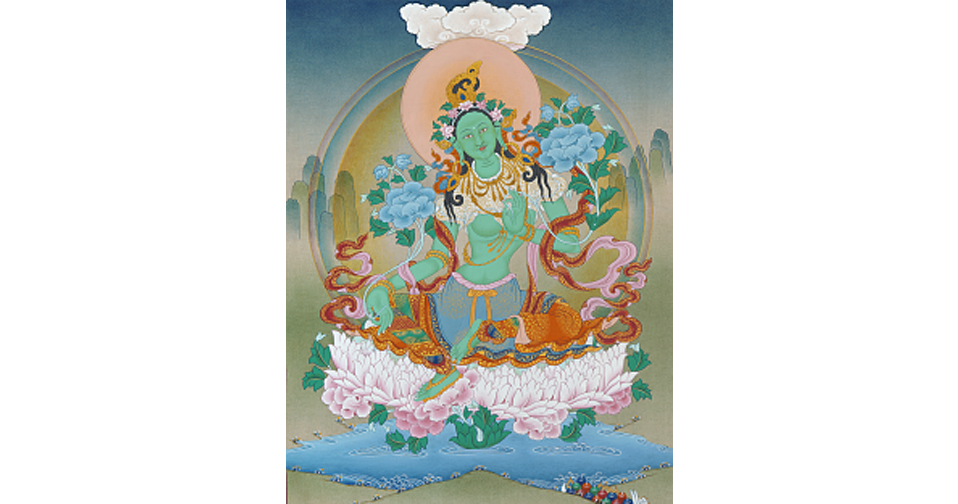
With the approach of the 2022 Nalandabodhi Tara Drupchen, we are pleased to offer a series of presentations and “studio sessions” that will allow students to connect with the image of Khadiravani Tara, or Green Tara, in a fresh and deeper way.
Stephanie Johnston and Julia Linderova will guide students in the contemplation of drawing Khadiravani Tara based on her traditional iconometrics (tikse) and symbolism. This is a method of drawing that follows a clear set of rules governing proportion and composition. The rules draw from the Buddha’s life and manifest in the geometric proportions of a drawing. The image used in these classes will be Khadiravani Tara.
The series will alternate class lectures, in which there will be studio time with guided practice on Saturdays mornings, with “studio sessions” on Tuesday evenings. The studio sessions will provide students an opportunity to ask specific questions about their drawings progress and also receive individual instruction on their drawings.
IF YOU ARE NOT ABLE TO ATTEND IN PERSON, LECTURES WILL BE RECORDED AND CAN BE VIEWED AT A LATER TIME.
Lectures will be recorded and available until Dec. 31.
Green Tara practice is a practice that can help to overcome fear and anxiety and unleash the power of one’s own compassion. Contemplating her image through tikse drawing offers another entry into this profound practice.
Through the science of creativity, one of the five sciences used at places of higher learning such as Nalanda, we can follow in their broad curriculum using thangka painting and the foundations of tikse and tikchö to draw Deities and help support our visualization practices.
 Stephanie Johnston, a Tibetan Buddhist practitioner since 1985 and student of Dzogchen Ponlop Rinpoche’s since 1996, is Nitartha Institute faculty and developed its Science of Creativity and the Arts courses. As a graphic designer and avid practitioner, she trains and supports practice instructors for Nalandabodhi. An alumni of Nova Scotia College of Art and Design, and certified in Museum studies, Renaissance Art Techniques, and Graphic Design, she loves digging into the symbolic and its applied meaning in art and everyday life.
 Julia Linderova has studied under Stephanie Johnston and RD Salga, a renowned master of the Karma Gadri tradition of thangka painting at Nitartha Summer Institute.. She has studied visual arts at Langara College in Vancouver, B.C. Julia’s aspiration is to help preserve the ancient technique of thangka painting and iconometrics while making it accessible for Westerners to connect with these sacred practices.
Upon registration, you will receive an email with Zoom links for all sessions, as well as information and links to the program Resource page . It contains a list of supplies you will need for the first class as well as a tikse grid and black and white image of Green Tara you will need to print.